A child-health analytics workspace connecting regional evidence, risk mapping, and local screening workflows.
Role
Data preprocessing & system integration (hackathon)
Period
Original project: October 2025; workspace documented in 2026
Status
Prototype
Illustrative StuntLytics project preview; not a recording of validated clinical use
The problem
Regional child-health data is difficult to turn into a practical monitoring workflow. Teams need to compare conditions, review risk signals, and identify areas for follow-up.
Contribution & scope
Documented role: Data preprocessing & system integration (hackathon).
Project implementation
For the original APHacton project: a synthetic dataset of 100,000 family records using variables derived from BPS and SSGI references.
A Random Forest preprocessing and prediction workflow integrated with Streamlit and Elasticsearch in the original project.
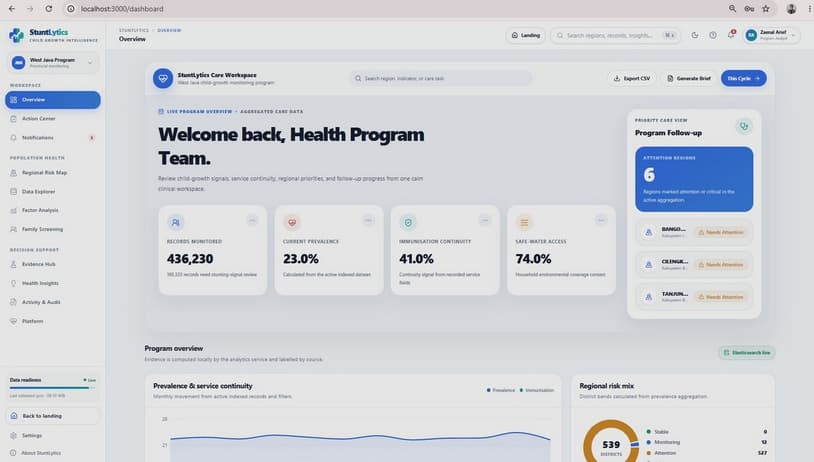
A current workspace covering regional dashboards, risk maps, a Data Explorer, and family screening with 18 structured inputs.
An evidence layer that limits optional Gemini narration to aggregated information.
The approach
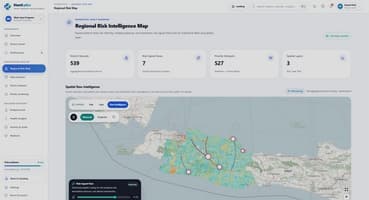
The current implementation combines a Next.js interface, FastAPI evidence services, Elasticsearch, and a local scikit-learn screening pipeline. Optional Gemini narration works from aggregated evidence. It develops the original hackathon concept into a broader analytics workspace. Regional Risk Intelligence is the West Java mapping module of StuntLytics, covering district-level monitoring, hotspots, and directional-flow signals; it is not counted as a separate project.
Architecture & workflow
01Regional dataset
02Elasticsearch
03FastAPI evidence service
04Local screening model
05Next.js workspace
06Monitoring + review
Technical challenges
Integrating preprocessing, model inference, indexed data, and the application interface.
Keeping screening signals distinct from clinical diagnosis.
Supporting local evidence summaries when optional external services are unavailable.
Project views
Dashboard image extracted from the owner's portfolio, page 1. Figures shown are interface content, not independently verified project outcomes.
Regional Risk Intelligence is the regional mapping module of the StuntLytics workspace.
The portfolio presents this map in the same application shell and links both entries to the same StuntLytics repository. It is not counted as a separate project or an independent validation result.